
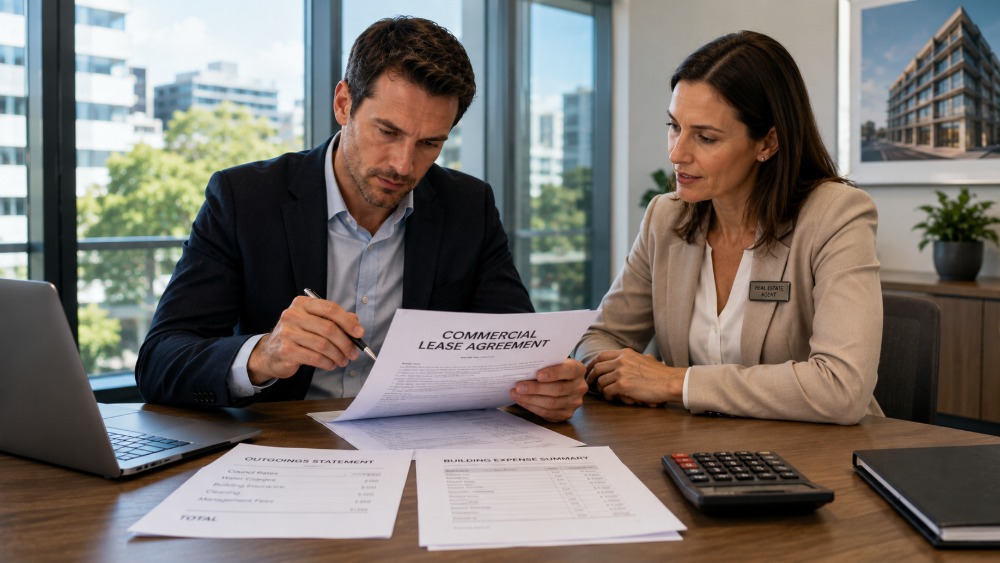
Commercial lease outgoings are the property’s running costs that a landlord passes on to the tenant, on top of base rent.
In Australia, they usually cover council rates, water charges, building insurance, cleaning, security, and common-area expenses, and sometimes land tax.
What you can actually be charged depends heavily on whether your lease is retail or commercial, because retail leasing laws in each state stop landlords from recovering certain costs.
The gap between what a landlord asks for and what the law allows can run into tens of thousands of dollars across a lease term.
This guide breaks down what tenants really pay, what they can refuse, and where the rules differ across New South Wales, Victoria, and Queensland.
What Do Commercial Lease Outgoings Actually Cost Tenants?
Outgoings are the day-to-day operating costs of running the premises, and a tenant typically pays them in addition to base rent.
Depending on the building and the lease, outgoings can add a meaningful sum on top of rent, which is why they are often the most negotiated and most disputed part of a commercial tenancy.
The exact figure depends on three things: the type of property, whether the lease is retail or commercial, and what the lease document says you have agreed to pay.
A tenant in a shopping centre faces a very different outgoings bill to an office tenant down the road, even when the rent looks similar.
Office and industrial tenants often carry a full share of building costs, while shopping-centre tenants also chip in towards centre management and shared facilities.
The golden rule is simple: a landlord can only recover an outgoing if the lease clearly says so, and, for retail premises, only if the law allows that cost to be passed on at all.
Which Outgoings Can a Landlord Recover From You?
A landlord can recover the costs of operating, maintaining and insuring the building, provided those costs are listed in the lease and reasonably incurred.
The most common recoverable outgoings are council rates, water and sewerage charges, building insurance, cleaning, gardening, security, fire-protection servicing, lift maintenance, and the electricity used in common areas.
In a multi-tenant building, you usually pay a proportion of these costs based on the floor area you occupy compared with the whole lettable area.
Centre or building management fees are also commonly recoverable in office and industrial leases, and in shopping centres, although retail laws can cap or restrict them.
The Queensland Small Business Commissioner sets out the standard list of recoverable items and confirms that, except in gross-rent leases, commercial tenants often contribute to rates, water, insurance, cleaning, management fees, and utilities, as explained in its outgoings guidance.
A landlord generally cannot make a profit on outgoings and should only pass on the actual cost they incur.
Which Costs Are Prohibited or Restricted in Retail Leases?
In retail leases, certain costs are prohibited or restricted by state legislation, even if the lease wording tries to pass them on.
Across the main states, the items that cannot be recovered include capital costs, depreciation of the building or plant, interest and fees on the landlord’s borrowings, and contributions to a sinking fund (in some states).
In New South Wales, these exclusions are written into the Retail Leases Act 1994, which states that capital costs, depreciation, and borrowing costs are not recoverable from the tenant.
Victoria takes the same approach under its Retail Leases Act 2003, where capital costs, depreciation, sinking-fund contributions, and borrowing costs are each excluded.
If a lease tries to recover one of these prohibited costs, that part of the lease is usually void, and a tenant who has paid it may be entitled to a refund.
This is why reading the outgoings schedule line by line matters so much: a long list of charges is not the same as a list of charges you are legally required to pay.
Can a Landlord Recover Land Tax From You?
Whether a landlord can recover land tax depends on the state and on whether the lease is retail or commercial, and the differences are significant.
For retail leases, the position across the three biggest states is set out below.
| State | Retail leasing law | Land tax recoverable in a retail lease? | How it works |
| New South Wales | Retail Leases Act 1994 | Yes, but limited | Capped on a “single holding” basis under section 26, so you only pay what the landlord would owe if that land were their only property |
| Victoria | Retail Leases Act 2003 | No | Section 50 prohibits recovery entirely, and now also blocks recovery of the new commercial and industrial property tax |
| Queensland | Retail Shop Leases Act 1994 | No | Section 7(3) excludes land tax from the definition of recoverable outgoings |
Victoria’s full ban on land tax recovery is confirmed in its Retail Leases Act 2003, and Queensland’s exclusion is set out in the Retail Shop Leases Act 1994.
Commercial (non-retail) leases are a different story, because they are governed mainly by the contract rather than a protective Act.
In many non-retail office or industrial leases, land tax recovery is mainly a matter of contract, subject to state-specific restrictions and the lease date, so tenants should check the clause carefully before signing.
Even then, a well-drafted clause should limit the tenant’s share to a “single holding” basis, so you are not subsidising land tax on other properties the landlord owns.
Are Capital Costs Part of Your Outgoings?
Capital costs are not outgoings in a retail lease, and they remain the landlord’s responsibility rather than the tenant’s.
Capital costs are one-off expenses that improve the property or replace a major part of it, such as installing a new roof, replacing the air-conditioning plant, or carrying out structural building work.
Routine repairs and maintenance, by contrast, are operating costs that keep the building running, and these can usually be recovered as outgoings.
The line between the two is one of the most common sources of dispute in commercial leasing, because a landlord has an incentive to treat a big-ticket replacement as “maintenance”.
A useful test is whether the work restores something to working order (likely maintenance) or adds new value and lasting life to the asset (likely capital).
For retail tenants, the law is firmly on your side here, so if a landlord tries to recover the cost of major works through your outgoings, that charge is open to challenge.
How Are Outgoings Charged: Gross, Net or Semi-Gross Leases?
The way you pay outgoings comes down to the lease structure, and there are three common models: gross, net and semi-gross.
Under a gross lease, an allowance for outgoings is built into the rent, and you pay a single figure with no separate adjustment, which gives you certainty but often a higher headline rent.
Under a net lease, you pay base rent plus the full range of outgoings, usually estimated and charged in advance, then reconciled against the actual costs at the end of the lease year.
A semi-gross lease sits in the middle, where the landlord covers some costs (often the statutory ones) and you pay the rest.
Net leases are most common for industrial property, while shopping centres frequently use detailed semi-gross or net arrangements with specific recovery clauses.
Knowing which model your lease uses tells you straight away how exposed you are to rising costs, because under a net lease, increases in rates, insurance and other charges flow through to you.
What Disclosure and Reconciliation Rights Do Tenants Have?
Retail tenants have strong rights to be told about outgoings before they sign, and to receive an honest reconciliation each year.
Under retail leasing laws, a landlord must give a disclosure statement that estimates the outgoings for the first year, and a tenant generally cannot be charged for outgoings that were not disclosed.
The landlord must then provide an annual estimate before each period and, in most states, an audited annual statement comparing the estimate against what was actually spent.
If you have overpaid against the estimate, you are refunded the difference; if you have underpaid, you are billed the shortfall.
These protections are powerful, because a missing or misleading disclosure statement can give a retail tenant the right to compensation or even to end the lease.
Commercial tenants outside retail laws do not get these statutory rights automatically, so the lease itself must spell out how outgoings are estimated, charged and reconciled.
What Does the Verraty Case Mean for Tenants Paying Land Tax?
The leading case on land tax recovery in retail leases is Verraty Pty Ltd v Richmond Football Club Ltd [2020] VSCA 267, where the Victorian Court of Appeal protected a tenant from paying its landlord’s land tax.
The lease started as a retail premises lease, which meant the clause requiring the tenant to pay land tax was void under section 50 of the Retail Leases Act 2003.
The landlord argued that once the tenant’s yearly occupancy costs rose above the $1 million threshold, the lease “jumped out” of the Act and the land tax clause sprang back to life.
The Court of Appeal rejected that argument, holding that a lease which is retail at the start stays retail for its whole term, even if costs later climb past the threshold.
For tenants, the lesson is clear: if your lease was a retail premises lease when you signed it, the land tax protection sticks, and amounts wrongly charged can be clawed back.
This case is a reminder that the label on a lease matters less than how the law characterises it at the moment it begins.
How Has Recent Law Reform Changed Commercial Leasing?
A major recent change for commercial tenants is in Queensland, where the Property Law Act 2023 commenced on 1 August 2025 and reshaped how commercial leases operate.
The new Act introduces a formal process for landlord consent to assignment, subletting and other requests, requiring the tenant to send a proposal notice and the landlord to respond with a decision notice, usually within one month.
Many of these rules cannot be contracted out of and apply even to leases signed before the Act began, so existing tenants and landlords are affected too.
Importantly, the reform does not change the long-standing rule that land tax and capital costs cannot be recovered from Queensland retail shop tenants, which remains in place under the Retail Shop Leases Act 1994.
In Victoria, land tax recovery has also tightened, with section 50 of the Retail Leases Act 2003 now extending its ban to the state’s new commercial and industrial property tax.
These changes show that outgoings rules are not static, and a clause that was acceptable a few years ago may now be unenforceable.
How Can Tenants Keep Outgoings Under Control?
The best way to control outgoings is to scrutinise them before you sign, then check every annual statement against your lease.
Recent CBRE commentary on the Sydney office leasing market noted that outgoings were increasing amid higher land tax, electricity and insurance costs, showing why tenants should check these charges carefully before signing or renewing.
Before signing or renewing a commercial lease, a tenant should work through a short checklist:
- Ask for the full schedule of outgoings and a written estimate, not a vague promise.
- Request the actual outgoings figures for the past two to three years to spot trends.
- Confirm whether the lease is retail or commercial, as this decides what can be recovered.
- Check that land tax, if charged, is limited to a single holding basis.
- Make sure capital costs, depreciation and the landlord’s borrowing costs are excluded.
- Confirm how your share is apportioned and whether there is an annual reconciliation.
Working through these points turns outgoings from a hidden risk into a predictable, manageable cost.
If a charge looks wrong, raise it in writing and ask the landlord to justify it against the lease before you pay.
Need Help Reviewing Your Commercial Lease Outgoings?
Commercial lease outgoings can quietly add tens of thousands of dollars to the cost of a tenancy, so it pays to know which charges are fair and which ones the law simply does not allow.
The team at my law firm reviews leases, checks disclosure statements and outgoings estimates, and makes sure you are not paying costs you can lawfully refuse.
As commercial leasing lawyers working with tenants and landlords across Australia, we offer clear, fixed-fee advice and plain-English answers, with no surprises on your bill.
Contact my law firm today by calling 1300-529-888.
Frequently Asked Questions
What are outgoings in a commercial lease?
Outgoings are the running costs of the premises that a landlord passes on to the tenant on top of base rent. They typically include council rates, water charges, building insurance, cleaning, security, common-area utilities and management fees. A landlord can only recover an outgoing if the lease states it, and retail laws restrict some charges.
Can a landlord charge land tax to a commercial tenant in Australia?
It depends on the lease type and state. In retail leases, Victoria and Queensland fully prohibit recovering land tax from tenants, while New South Wales allows it only on a limited single-holding basis. In ordinary commercial or industrial leases, land tax can usually be passed on if the lease specifically allows it.
What outgoings can a landlord not recover from a tenant?
In retail leases, a landlord generally cannot recover capital costs, depreciation, or interest on their borrowings. Sinking-fund contributions are prohibited or restricted depending on the state, with NSW allowing them only under specific statutory conditions for retail shopping centres. Land tax is also non-recoverable in Victoria and Queensland retail leases. Amounts wrongly charged may be refundable.
What is the difference between a gross lease and a net lease?
In a gross lease, an allowance for outgoings is built into the rent, so the tenant pays one figure with no separate adjustment for cost changes. In a net lease, the tenant pays base rent plus outgoings, usually estimated in advance and reconciled against actual costs each year. Net leases give tenants less cost certainty.
Are capital costs included in commercial lease outgoings?
No, capital costs are not recoverable outgoings in a retail lease and remain the landlord’s responsibility. Capital costs are major one-off expenses such as replacing a roof or air-conditioning plant, or structural work. Routine repairs and maintenance can usually be recovered. Disputes often arise when a landlord treats a large replacement as ordinary maintenance.