
Quick answer: A retail lease is a lease over premises used for selling goods or services to the public, captured by retail leasing legislation in the relevant Australian state or territory. A commercial lease is any other non-residential lease. The classification determines disclosure obligations, recoverable outgoings, minimum lease term, rent review rules, and dispute resolution rights.
Commercial Lease vs Retail Lease at a Glance
| Feature | Retail Lease | Commercial Lease |
|---|---|---|
| Disclosure statement | Mandatory before lease entered into | Not required |
| Outgoings | Restricted by statute, must be itemised | Whatever the lease says, by negotiation |
| Lease preparation costs | Cannot be passed to the tenant | Often paid by the tenant |
| Minimum lease term | 5 years in VIC, SA, WA, NT | No statutory minimum |
| Rent reviews | Once per year, ratchet clauses void | Multiple methods allowed, ratchet clauses enforceable |
| Dispute resolution | Mandatory mediation, tribunal pathway | Court proceedings only, unless lease provides otherwise |
Australia’s retail property operators industry is valued at approximately $37.2 billion in 2026, with around 61,505 businesses involved in leasing retail premises (IBISWorld, June 2025).
The classification of any individual lease as retail or commercial determines which protections apply, which costs are recoverable, and which legal regime governs the relationship.
Commercial leases and retail leases in Australia are governed by different laws and produce very different rights and obligations for landlords and tenants.
The classification of a lease as retail or commercial is not a matter of preference or labelling.
It is determined by state and territory legislation, and getting it wrong can leave a lease partly unenforceable, expose a landlord to penalties, or strip a tenant of statutory protections worth tens of thousands of dollars over the term.
This article covers what each lease type is, how every Australian state and territory classifies them, the practical differences between the two in everyday lease management, and what happens when a lease falls into a grey area or is wrongly treated as commercial when it should be retail.
What Is a Retail Lease in Australia?
A retail lease is a lease over premises used for the sale of goods or services to the public, where that lease is captured by the relevant retail leasing legislation in the state or territory where the premises are located.
Every state and territory in Australia has its own retail leasing legislation, and each one defines what counts as a retail lease slightly differently.
In most jurisdictions, a lease is treated as retail if the premises are used for one of the prescribed retail businesses listed in the legislation, or if the premises are located in a retail shopping centre.
The classic examples include cafes, restaurants, hairdressers, clothing stores, takeaway outlets, beauty salons, pharmacies, and travel agencies.
Retail businesses captured by this legislation are economically significant: Australian Bureau of Statistics figures show retail turnover rose 4.9% in the year to June 2025, with monthly turnover continuing to grow despite the rise of e-commerce.
In New South Wales, the Retail Leases Act 1994 (NSW) defines a retail shopping centre as a cluster of premises with at least five shops used for retail business, all owned by the same landlord, located in the one building or in adjoining buildings, and promoted as a shopping centre.
Service-based businesses such as gyms and fitness centres, and small bars with a maximum patron capacity of 120, were added to the list of prescribed retail businesses in NSW from 1 January 2023.
Retail leases attract a layer of statutory protections that do not apply to commercial leases.
These protections include mandatory disclosure obligations on the landlord, restrictions on what costs can be passed to the tenant, limitations on rent reviews, dedicated dispute resolution pathways through state-based small business commissions and tribunals, and minimum lease terms in several jurisdictions.
The legislation overrides any inconsistent terms in the lease itself.
If a retail lease contains a clause that conflicts with the relevant Act, that clause is generally void and the statutory provision applies in its place.
What Is a Commercial Lease in Australia?
A commercial lease is a lease over premises used for any business purpose that is not residential and that is not captured by the retail leasing legislation in the relevant state or territory.
Commercial leases typically cover office space, warehouses, factories, industrial sites, distribution centres, medical centres outside shopping centres, professional services suites, and storage facilities.
The defining feature of a commercial lease is that it is largely governed by the terms negotiated between the parties, with the underlying common law and general property legislation filling any gaps.
Commercial leases in Australia are generally regulated by the relevant state property and conveyancing legislation, such as the Conveyancing Act 1919 in New South Wales, the Property Law Act 1958 in Victoria, the Property Law Act 1974 in Queensland, and equivalent legislation in other jurisdictions.
There is no requirement for a landlord to provide a disclosure statement before entering into a commercial lease, no statutory minimum term, no automatic restriction on what outgoings can be passed through to the tenant, and no statutory cap on rent reviews.
The trade-off is that commercial tenants have far fewer statutory protections.
If a commercial lease contains an onerous clause that the tenant has signed up to, that clause will generally be enforceable, even if the same clause would be void in a retail lease.
For commercial tenants, the practical implication is that almost everything must be negotiated upfront and recorded in the lease, because there is no statutory safety net to fall back on later.
Why Does the Distinction Between Commercial and Retail Leases Matter?
The classification of a lease changes almost every part of the legal relationship between the landlord and the tenant.
It changes what the landlord must disclose, what costs the tenant can be charged, what the rent review process looks like, what the minimum lease term is, how disputes are handled, what happens at the end of the term, and what rights each party has if the other breaches the lease.
A landlord who treats a retail lease as commercial may breach the disclosure obligations under the relevant Act, lose the right to recover certain outgoings, expose the lease to termination by the tenant, and face compensation claims for any loss the tenant has suffered.
A tenant who signs a commercial lease in circumstances where the lease should have been retail may pay outgoings they were never legally required to contribute to, accept rent ratchet clauses that retail legislation would have voided, agree to lease preparation costs the legislation prohibits, and lose access to low-cost dispute resolution through the relevant small business commission.
The risks run in both directions, and the financial consequences over a five or ten year term can be very large.
A retail lease that has been wrongly treated as commercial for several years may also reduce the sale price of the property when the landlord comes to sell, because a purchaser conducting due diligence will identify the non-compliance and factor it into the price.
How Does Each State and Territory Classify Retail Leases?
Australian retail leasing legislation is not uniform.
Each state and territory sets its own definition of a retail lease, its own thresholds, its own list of prescribed retail businesses, and its own minimum term, disclosure, and outgoings rules.
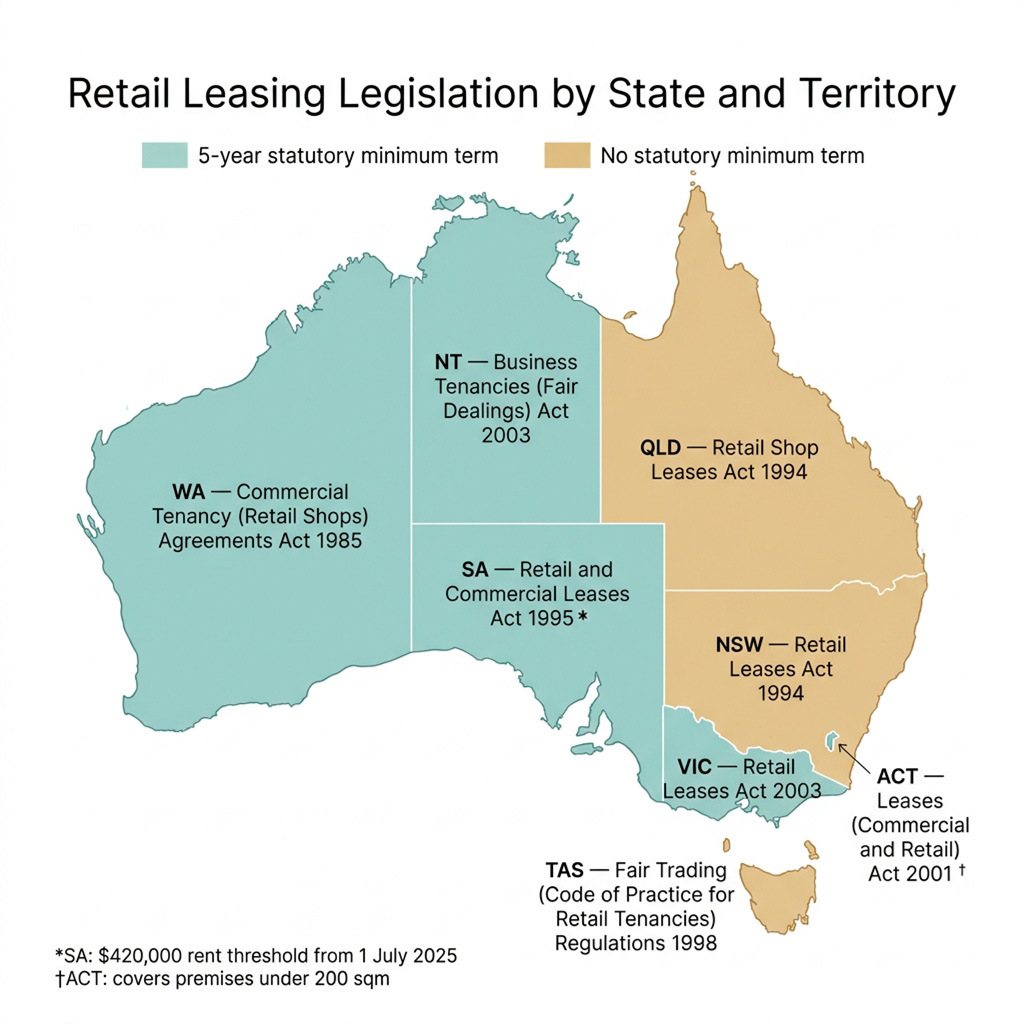
The table below summarises the legislation that determines whether a lease is retail in each jurisdiction, the minimum lease term where one applies, the disclosure timing, and the key threshold or exclusion that most often determines classification.
| State or Territory | Retail Leasing Legislation | Minimum Term | Disclosure Required | Key Threshold or Exclusion |
|---|---|---|---|---|
| New South Wales | Retail Leases Act 1994 (NSW) | No statutory minimum (since 2017) | At least 7 days before lease entered into | Excludes shops with lettable area of 1,000 sqm or more, and leases of 25 years or more |
| Victoria | Retail Leases Act 2003 (Vic) | 5 years (including options) | At least 14 days before lease entered into | Excludes leases with annual occupancy costs over $1 million, and office premises in commercial office buildings |
| Queensland | Retail Shop Leases Act 1994 (Qld) | No statutory minimum | At least 7 days before lease entered into | Generally excludes premises with floor area over 1,000 sqm |
| South Australia | Retail and Commercial Leases Act 1995 (SA) | 5 years (including options) | Before lease entered into | Applies where annual rent does not exceed $420,000 (excluding GST), threshold raised from $400,000 on 1 July 2025 |
| Western Australia | Commercial Tenancy (Retail Shops) Agreements Act 1985 (WA) | 5 years (including options) | At least 7 days before lease entered into | Excludes shops with lettable area over 1,000 sqm |
| Tasmania | Fair Trading (Code of Practice for Retail Tenancies) Regulations 1998 | No statutory minimum | Before lease entered into | Retail Leases Act 2022 has been passed but has not yet fully commenced |
| Australian Capital Territory | Leases (Commercial and Retail) Act 2001 | No statutory minimum | Before lease entered into | Covers retail premises and commercial premises with lettable area under 200 sqm |
| Northern Territory | Business Tenancies (Fair Dealings) Act 2003 | 5 years (including options) | Before lease entered into | Disputes are administered by the Commissioner of Business Tenancies |
The differences between jurisdictions are significant in practice.
A landlord operating across multiple states should not assume that a lease drafted for premises in Sydney will work, unchanged, for premises in Melbourne, Adelaide, or Perth.
The Australian Capital Territory legislation is particularly broad in its application.
The Leases (Commercial and Retail) Act 2001 captures not only retail premises but also commercial premises with a lettable area under 200 square metres used for general office or business purposes, and also covers premises leased to associations, charities, child care centres, sports centres, art galleries, and gardening supply centres.
South Australia is unusual in using a rent threshold rather than a use-based or area-based test as the primary trigger for the legislation.
Tasmania remains in a transitional period, with the Retail Leases Act 2022 passed but not fully commenced, meaning the older Code of Practice for Retail Tenancies continues to apply to retail tenancies in the meantime.
What Are the Key Practical Differences Between Commercial and Retail Leases?
Once a lease has been classified as either commercial or retail, several practical consequences flow from that classification.
The differences below apply broadly across most jurisdictions, with state-specific variations in detail.
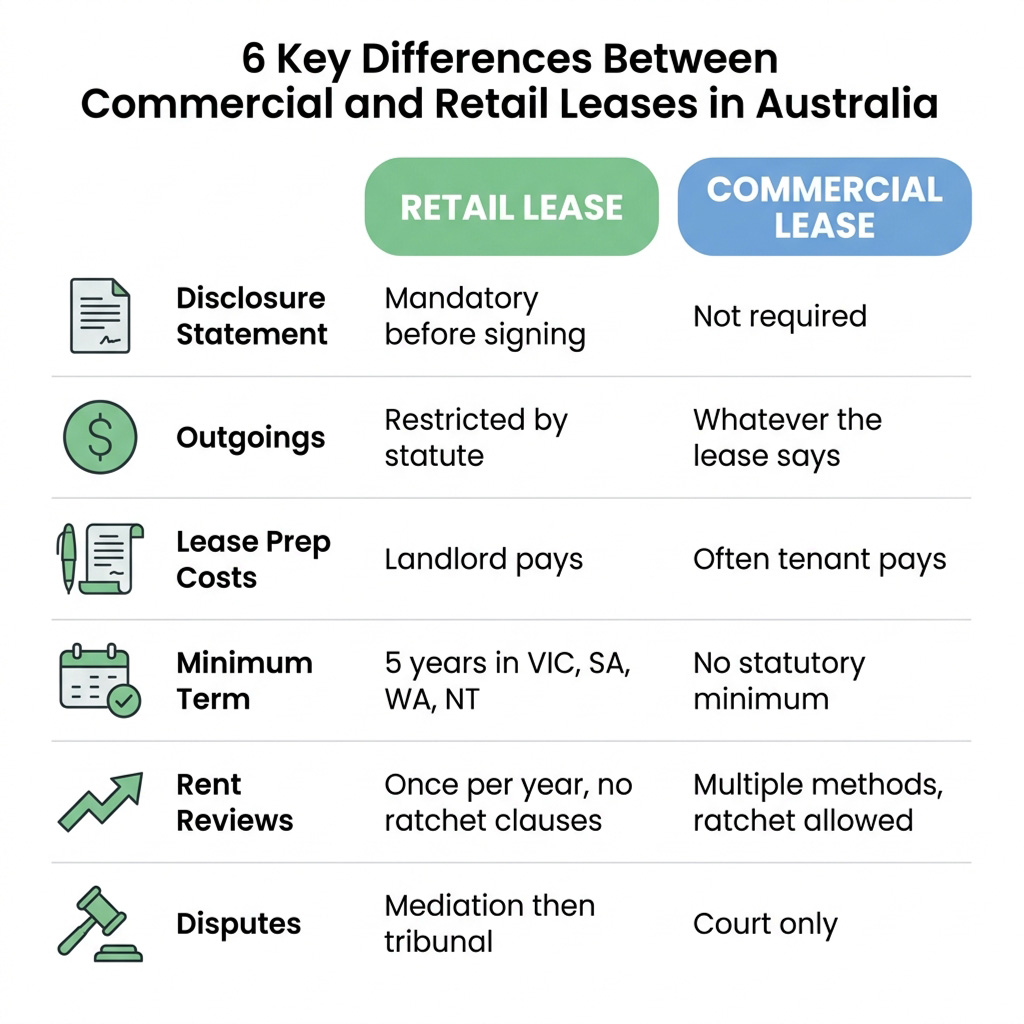
This is a simplified guide. State-specific thresholds apply, and the ultimate consumer test confirmed in CB Cold Storage [2017] VSCA 178 may also bring services-based businesses within retail leasing legislation.
How Do Disclosure Obligations Differ Between Commercial and Retail Leases?
Disclosure is one of the most significant practical differences between commercial and retail leases in Australia.
Under the retail leasing legislation in every Australian state and territory, a landlord must give the prospective tenant a disclosure statement before the lease is entered into.
The disclosure statement sets out the key terms of the lease, including the rent, the rent review method and timing, the estimated outgoings, the lettable area, the permitted use, the trading hours, the fit-out obligations, and any incentives or rent-free periods.
Failure to provide a compliant disclosure statement can give the tenant a right to terminate the lease, claim compensation for any loss suffered, or both.
In New South Wales, the disclosure statement must be given at least seven days before the lease is entered into, and must be in the form prescribed by the Retail Leases Regulation 2022.
In Victoria, the disclosure statement must be given at least 14 days before the lease is entered into.
Commercial leases carry no equivalent statutory disclosure obligation.
The tenant is expected to undertake their own due diligence, and there is no automatic right to terminate or seek compensation if the landlord has not volunteered information about the property, the outgoings, or the building services.
What Outgoings Can a Retail Tenant Be Charged?
Retail leasing legislation across Australia restricts the types of outgoings a landlord can recover from a retail tenant.
Common restrictions include prohibitions on recovering land tax (in Queensland and on a single-holding basis in New South Wales), capital costs, depreciation, interest on the landlord’s borrowings, contributions to sinking funds for major capital works, and head lease rent.
Outgoings must usually be itemised in the disclosure statement and the lease, and the landlord is required to provide annual statements of actual expenditure with supporting documentation.
The tenant has no liability for outgoings that were not properly disclosed at the start of the lease.
Commercial leases operate under no such constraints by default.
If the lease says the tenant must pay all outgoings the landlord chooses to pass on, that is what the tenant has agreed to, and the courts will generally enforce it absent unconscionability or some other vitiating factor.
For commercial tenants, the only protection against unfair outgoings clauses is the negotiation that takes place before the lease is signed.
Who Pays the Lease Preparation Costs?
Most retail leasing legislation prohibits the landlord from passing on the cost of preparing the lease document, obtaining mortgagee consent, or registering the lease to the retail tenant.
This is one of the simplest but most overlooked differences between the two lease types.
A retail tenant who is asked to pay the landlord’s legal costs for lease preparation can refuse, because the clause requiring payment is generally void.
In New South Wales, key money on the assignment of a retail lease is also prohibited, and any clause requiring it is unenforceable.
Commercial leases, by contrast, often require the tenant to pay the landlord’s legal fees in full or in part, and that arrangement is enforceable.
The cost can run into thousands of dollars, depending on the complexity of the lease, and is paid in addition to the tenant’s own legal fees for reviewing the document.
What Is the Minimum Lease Term for Each Lease Type?
In Victoria, South Australia, Western Australia, and the Northern Territory, retail leasing legislation requires a minimum lease term of five years, including any options to renew.
The intent is to give retail tenants enough security of tenure to recover their fit-out investment and establish the business at the location.
In Victoria and Western Australia, a tenant may waive the five-year minimum, but only after obtaining a certificate from the Victorian Small Business Commission, the State Administrative Tribunal, or a lawyer not acting for the landlord, confirming the waiver was made with the tenant’s full understanding of the consequences.
In New South Wales, the previous minimum five-year term was abolished in 2017, so there is no longer any statutory minimum term for retail leases in that state.
Commercial leases have no statutory minimum term anywhere in Australia.
The lease can run for one year, three years, ten years, or any duration the parties agree to, including short-term leases of a few months to support a temporary use of the premises.
How Are Rent Reviews Regulated Under Each Lease Type?
Retail leasing legislation typically restricts the methods that can be used to review rent, requires reviews to be conducted only once per year, and renders ratchet clauses void.
A ratchet clause is a clause that prevents the rent from going down on a market review, even when the market rent has fallen.
In every Australian retail leasing regime, a clause of this kind is generally unenforceable, and the rent must rise or fall in line with the actual market.
Retail leasing legislation also prohibits the landlord from using more than one method of rent review in a single year (for example, combining a CPI increase with a fixed percentage increase in the same review), which is a common feature of commercial leases.
Commercial leases can include ratchet clauses, multiple rent review methods compounding in the same year, market reviews timed to match the option exercise, and other arrangements that would be void in a retail lease.
This is one of the areas where commercial tenants pay the most dearly for their lack of statutory protection over a long lease term.
How Are Disputes Handled Under Each Lease Type?
Every Australian state and territory provides a dedicated dispute resolution pathway for retail leases through a small business commission, retail tenancy tribunal, or equivalent body.
In New South Wales, retail tenancy disputes are first mediated by the Office of the NSW Small Business Commissioner, with unresolved matters referred to the NSW Civil and Administrative Tribunal (NCAT).
In Victoria, retail leasing disputes are mediated by the Victorian Small Business Commission and then heard in the Victorian Civil and Administrative Tribunal (VCAT).
In Queensland, mediation is provided through the Queensland Small Business Commissioner, with unresolved matters referred to the Queensland Civil and Administrative Tribunal (QCAT).
The process is intentionally designed to be cheaper, faster, and less formal than civil court proceedings, with each party often required to bear their own costs at the tribunal stage.
Commercial leases offer no equivalent statutory dispute resolution pathway.
A dispute under a commercial lease must generally be pursued through the courts, with all the cost and delay that involves, unless the lease itself includes a private dispute resolution clause requiring mediation or arbitration.
When Does a Lease Fall Into a Grey Area?
The line between commercial and retail leases is not always clear, and grey areas are common in practice.
Service-based businesses are a frequent source of disputes about classification.
A dental practice in a standalone professional suite may be a commercial lease, while the same practice operating from a shopping centre may be retail because of its location, even though the business is identical and the patient base is similar.
The leading authority on classification is the Victorian Court of Appeal’s decision in IMCC Group (Australia) Pty Ltd v CB Cold Storage Pty Ltd [2017] VSCA 178, which confirmed that the “ultimate consumer test” applies in determining whether premises are retail.
The court held that a wholesale cold storage warehouse was a retail premises under the Retail Leases Act 2003 (Vic), because the tenant’s customers were the ultimate consumers of the storage service, even though they were businesses rather than members of the public.
The High Court refused special leave to appeal in December 2017, leaving CB Cold Storage as the binding authority.
An earlier Supreme Court of Victoria decision, Fitzroy Dental Pty Ltd v Metropole Management Pty Ltd [2013] VSC 344, reached a similar conclusion regarding a conference room hire business, reinforcing the wide scope of “retail” under Australian retail leasing legislation.
The economic shift behind the widening reach of retail leasing legislation is significant: retail trade has fallen from 56.2% of total household consumption in 1959-60 to 33.2% in 2022-23 (Australian Bureau of Statistics), as households spend more on services, and court decisions have correspondingly expanded the definition of “retail” to include service-based businesses that earlier interpretations may have excluded.
Mixed-use premises also create classification challenges.
If part of a tenancy is used for retail sales and part is used for storage or warehousing not accessible to the public, the lease may be partially captured by retail legislation, depending on the dominant use of the premises and the wording of the relevant Act.
Premises in a building that contains five or more retail tenants under common ownership can be drawn into the retail leasing regime even where the individual tenant operates a non-retail business.
This is because the legislation in several states defines a shopping centre by the cluster of tenants rather than the activity of any single occupier, so an accountant or insurance broker leasing space in a building that also contains five or more retail shops may find themselves operating under retail leasing legislation without realising it.
Premises that change use during the lease can also move in and out of the retail leasing regime.
A tenant who starts the lease running an office and then opens a retail showroom from the same premises during the term may shift the lease from commercial to retail, depending on the dominant use test in the relevant state.
In every grey case, the classification is determined by the actual use of the premises, the physical layout, the location, and the wording of the relevant Act, not by what the parties have called the lease in the document.
What Happens If a Retail Lease Is Wrongly Treated as Commercial?
Misclassifying a retail lease as commercial is one of the more costly mistakes in commercial property practice.
If a lease is in fact a retail lease but has been entered into without a disclosure statement, the tenant may have the right to terminate the lease and claim compensation for any loss suffered as a result.
In New South Wales, this right exists in the first six months of the lease.
In Western Australia, the tenant may give a notice of termination and the lease will end 14 days after the notice is given.
Outgoings the landlord has charged the tenant in breach of the relevant Act may need to be refunded, sometimes covering several years of payments.
Lease preparation costs that the tenant has paid in breach of the legislation may also need to be returned.
Ratchet clauses, key money provisions, prohibited refurbishment costs, and other void terms will be unenforceable, even if the tenant signed the lease and paid under those terms for years.
For the landlord, the discovery that a lease has been wrongly classified can also affect the lease’s value as part of a sale of the property, because a purchaser conducting due diligence will identify the non-compliance and factor it into the price, or require the landlord to remedy the breaches before settlement.
The cost of getting classification wrong is rarely the lawyer’s fee for sorting it out at the start.
It is the years of disputed payments, void clauses, terminated leases, and renegotiated terms that follow.
For tenants who realise that a commercial lease should in fact have been retail, the first step is usually to obtain a written legal opinion on the classification issue and the available remedies, then approach the landlord with a clear position before any further rent or outgoings are paid.
Need Help With a Commercial or Retail Lease in Australia?
Whether you are a landlord drafting a lease for the first time, a tenant about to sign a long-term commitment, or either party trying to work out whether an existing arrangement has been correctly classified, getting the lease type right is the foundation of every other decision that follows.
As commercial lease lawyers in Australia, my law firm offers fixed-fee advice on lease classification, drafting, review, and dispute resolution for both commercial and retail leases across every Australian state and territory.
Contact the team today by calling 1300 529 888 to talk through your lease and find out exactly where you stand.
Frequently Asked Questions
Is a retail lease the same as a commercial lease?
No. A retail lease is a specific type of lease covered by retail leasing legislation in the state or territory where the premises are located. A commercial lease is any non-residential lease not captured by that legislation. Retail leases attract statutory protections around disclosure, outgoings, rent reviews, and dispute resolution that commercial leases do not.
How do I know if my lease is retail or commercial?
The classification is determined by the legislation in the state or territory where the premises are located, not by what the parties call the lease. It depends on the use of the premises, the location, the floor area, the type of business, and in some states the rent payable. Premises used for prescribed retail businesses or located in a shopping centre are usually retail.
Can a landlord make a tenant pay legal fees on a retail lease?
In most Australian states and territories, retail leasing legislation prohibits the landlord from passing the cost of preparing the lease, obtaining mortgagee consent, or registering the lease on to the retail tenant. Any clause requiring the tenant to pay these costs is generally void. On a commercial lease, the tenant can be required to pay the landlord’s legal fees.
What is the minimum lease term for a retail lease in Australia?
The minimum term for a retail lease depends on the state. Victoria, South Australia, Western Australia, and the Northern Territory require a minimum term of five years including any options to renew. New South Wales abolished its minimum term in 2017, while Queensland, Tasmania, and the Australian Capital Territory have no statutory minimum. Commercial leases have no statutory minimum term anywhere in Australia.
What happens if a landlord does not give a retail tenant a disclosure statement?
If a landlord fails to provide a compliant disclosure statement before a retail lease is entered into, the tenant generally has the right to terminate the lease within a set period, claim compensation for any loss suffered, or both. In NSW, this right exists in the first six months. In WA, the tenant may give 14 days’ notice to terminate.
Can a commercial lease become a retail lease during the term?
Yes. If the use of the premises changes during the lease so that it falls within the definition of a retail shop in the relevant state or territory, the lease may move from commercial to retail and become subject to retail leasing legislation. This commonly happens when a tenant adds a retail component, or when statutory amendments expand the list of prescribed retail businesses.